Choose a place worth exploring
A fictional map begins with a question: where are the characters going, and what lies between them and their destination? Choose a place from a story you know reasonably well. It might be a whole invented kingdom, but a smaller setting often works better: a mysterious house, a village, a stretch of forest or the route between a school and a secret meeting place.
Pick a scene or short sequence that gives you several location clues. A character may cross a bridge before reaching a market, look up at a tower from a garden or hear the sea from a bedroom. You do not need a story that includes a ready-made map. The pleasure of this activity is noticing how much geography a writer can suggest without drawing it for you.
Collect clues before you draw
On a spare sheet of paper, list the places named in the story. Add details about how they relate to one another: beside, beyond, uphill from, across or a short walk away. Movement is especially useful. If a character leaves the bakery, passes a fountain and arrives at the library, you have a possible route and an order for three landmarks.
Make two columns labeled “The story says” and “I imagine.” Put direct clues in the first column and your own ideas in the second. The story might say that a path winds through trees but never say which direction it runs. You are free to choose its shape, as long as you know that choice is yours. If you want to revisit a clue later, jot down a chapter or scene name beside it. Exact page numbers are optional and may differ between editions.
Watch for clues that seem to conflict. Perhaps one scene makes a journey feel quick and another makes it feel long. Rather than forcing every detail into a precise grid, mark the area as uncertain or adjust the route to allow for a detour. Fictional spaces do not always have enough information for a single, definitive map.
Sketch the shape of the place
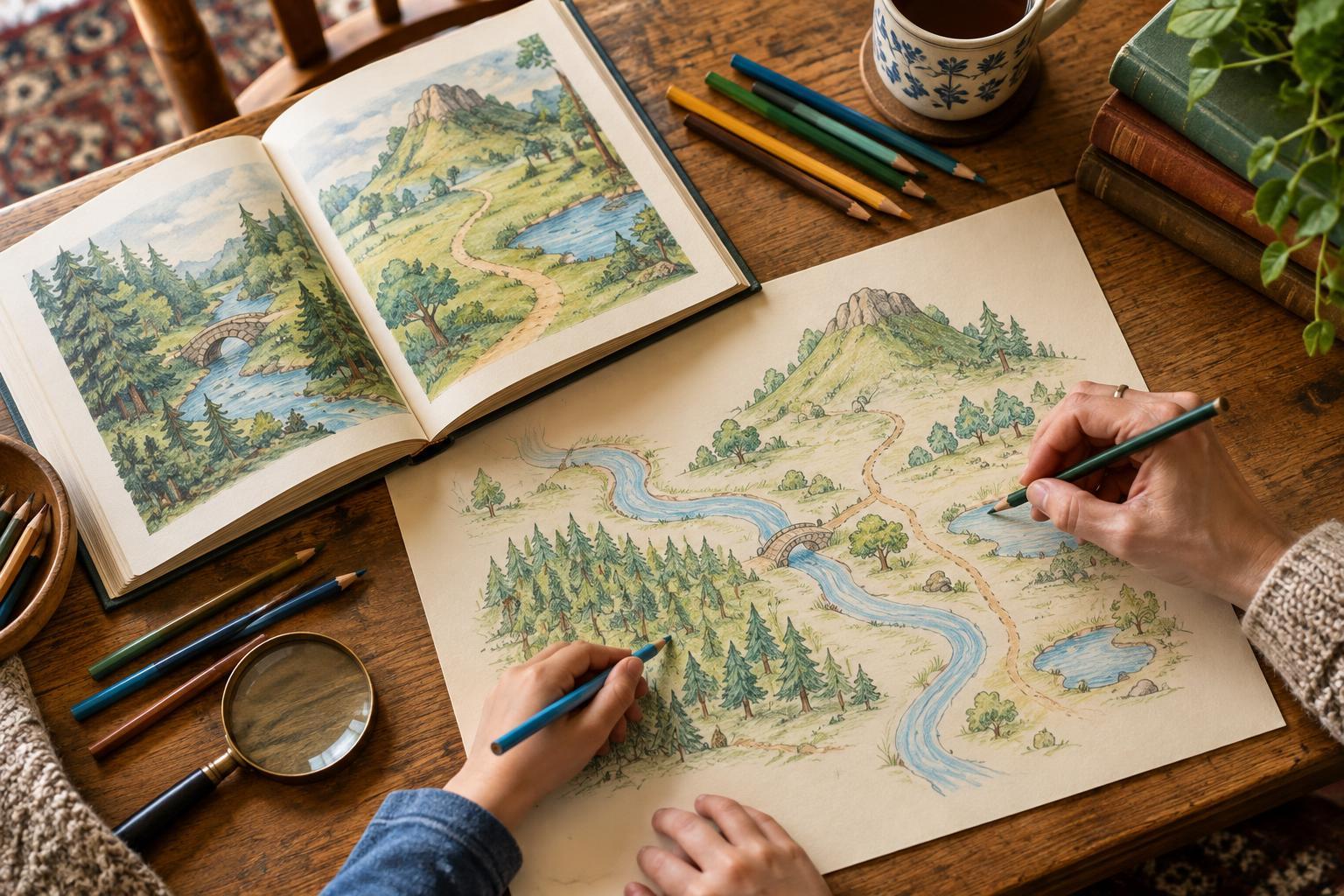
Start lightly, with a few large features: a coastline, a main road, a river or the outline of a building. Then place the landmarks you can locate with the most confidence. A pencil is handy because moving a bridge or turning a path may help several clues fit together. Try small symbols for repeated features, such as squares for buildings and clusters of circles for trees.
Next, trace a character’s route with a finger. Does the sequence of places match what happens in the story? Can someone reach the gate without crossing the river twice? This check is more useful than making the drawing look polished. A map can be playful and still help you think carefully about the setting.
Add a simple key so another reader can understand your marks. You might use a solid line for a route described in the story and a dotted line for one you invented. A question mark can show an uncertain location. A compass rose can help you stay consistent, but you do not need exact distances or a formal scale unless the story gives you enough information to use one.
Make the map tell a story
Once the main layout works, add details that reveal what the place feels like. A narrow path can emphasize a difficult journey; a wide, empty square can make a meeting place seem exposed. Consider labeling locations with a character’s name for them as well as their official name, if the story gives you both. Keep decorative details separate from confirmed clues so the reader can tell interpretation from evidence.
For a shared activity, invite each person to map the same setting independently before comparing drawings. Ask, “Which clue led you to put that building there?” rather than “Whose map is right?” Differences can lead to a lively discussion of what the text establishes, what it leaves open and how each reader pictured the space. Younger readers can map a single room or journey; older readers may enjoy mapping several connected scenes.
Return to the story with fresh eyes
Set the finished map beside the book and reread a scene that takes place on it. Notice whether the route now feels clearer or whether you have found a detail you missed. You can revise the map in another color to show what changed. That visible revision is part of the activity, not a mistake to hide.
A story-inspired map is not an answer key. It is a record of close attention and imagination working together. Whether you end up with a detailed city plan or a quick sketch of three landmarks, the drawing gives you a new way to explore where a story happens and why that place matters.