Start with a story-shaped plan
A book-themed scavenger hunt needs only a handful of books, a few clues, and somewhere to explore. Begin by deciding what players will search for: particular books, objects that appear in a story, or clues that lead from one reading spot to another. A familiar book can provide a ready-made theme, but there is no need for everyone to have read it. A hunt about journeys, mysteries, animals, or imaginary worlds gives newcomers plenty to work with.
Choose the playing area before writing clues. One room is enough for younger children or a quick activity; several rooms offer more variety for experienced searchers. Decide where the hunt will end and work backward from there. The final destination might hold a book to read together, a bookmark-making station, or a note inviting players to invent the next chapter. A clear ending makes the search feel like a small story rather than a series of unrelated errands.
Make clues from books and bookish details
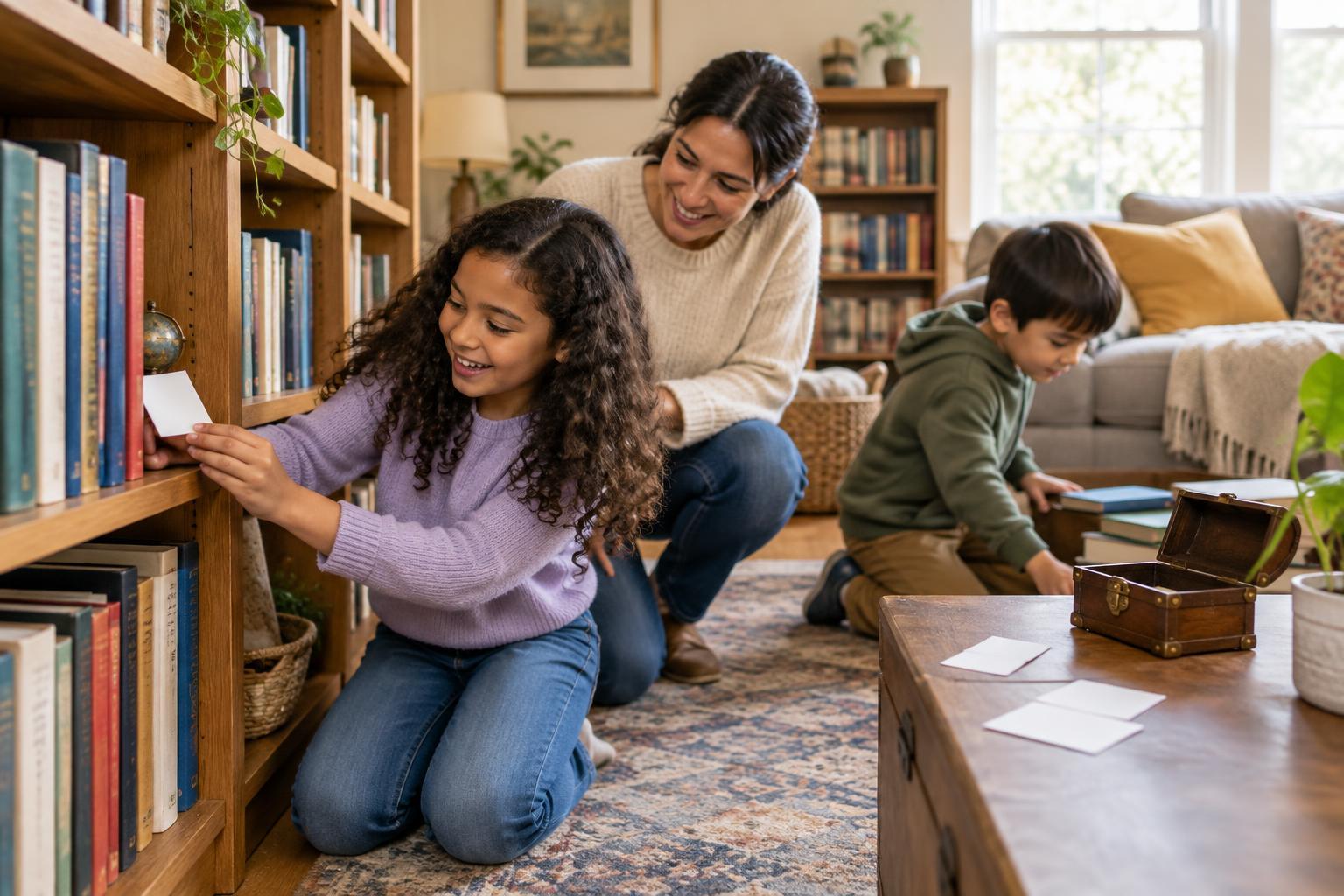
Clues can point to a book by its cover, title, subject, or place on the shelf. For example: “Find a book with a creature on the cover,” or “Look for a story whose title mentions the sea.” If your shelves do not have an obvious match, set out a small selection of books first. Players should be able to solve a clue by looking closely, not by guessing what the host had in mind.
You can also borrow the feel of a story without hiding anything inside a book. A mystery-themed clue might lead to a magnifying glass; a journey-themed clue might point to a map. If you do tuck a note into a book, use a loose slip of paper and avoid taping or marking pages. Write down the intended clue sequence as you set up so you can check that every step leads somewhere reachable.
Match the challenge to your players
A good hunt lets everyone contribute. For players who are not yet reading independently, use simple drawings, colors, or an adult who reads each clue aloud. Older players may enjoy riddles, anagrams, or a clue that asks them to compare two covers. In a mixed-age group, pair players up or give different jobs: one reads, one spots visual details, and one keeps track of the clues already found.
Keep instructions short and offer a hint if a group gets stuck. You might agree that players can ask for one hint at each stop, with no penalty. If someone has limited mobility or a hard time reaching shelves, place clues at comfortable heights and let them help solve rather than retrieve every item. The goal is shared discovery, not a test of speed, reading level, or knowledge of your home.
Set the scene without making a mess
Before players arrive, walk the route once as if you were following the clues for the first time. Make sure a clue cannot accidentally point to several places, and keep hiding spots away from fragile objects, electrical equipment, and spaces that are off-limits. A note on a shelf, beside a reading lamp, or under a cushion is usually enough. Tell players at the start that books should be handled gently and that there is no need to pull every volume off the shelf.
A little atmosphere can make the hunt memorable without much preparation. Give the group a playful mission, such as finding a lost library card for a fictional explorer. Place the first clue in an envelope and announce a few simple boundaries: which rooms are in play, whether players should stay together, and what to do when they find a clue. For a calmer hunt, skip the timer. If players enjoy a challenge, invite them to finish before a chosen song ends rather than making the activity a race.
Let the ending open another story
When the final clue is found, give players a chance to talk about what they noticed. Which cover caught their eye? Was there a clue they solved in an unexpected way? The answers may point toward a book they want to explore next. You can end by reading a chapter, letting each person choose a book to browse, or asking the group to create one new clue for someone else to solve.
Save any clues that worked well. Next time, swap the theme, change the route, or invite players to host the hunt themselves. A book-themed scavenger hunt is most fun when the books are more than props: they become doors to questions, conversations, and the pleasure of looking again at a familiar shelf.