What are story dice?
Story dice are cubes with a different picture or word on each face. Instead of telling you how many spaces to move, a roll gives you ingredients for a story: perhaps a fox, a locked door and a storm. The pleasure is in finding a connection nobody expected. A fox might be trying to open the door, hiding behind it or carrying its key through the rain.
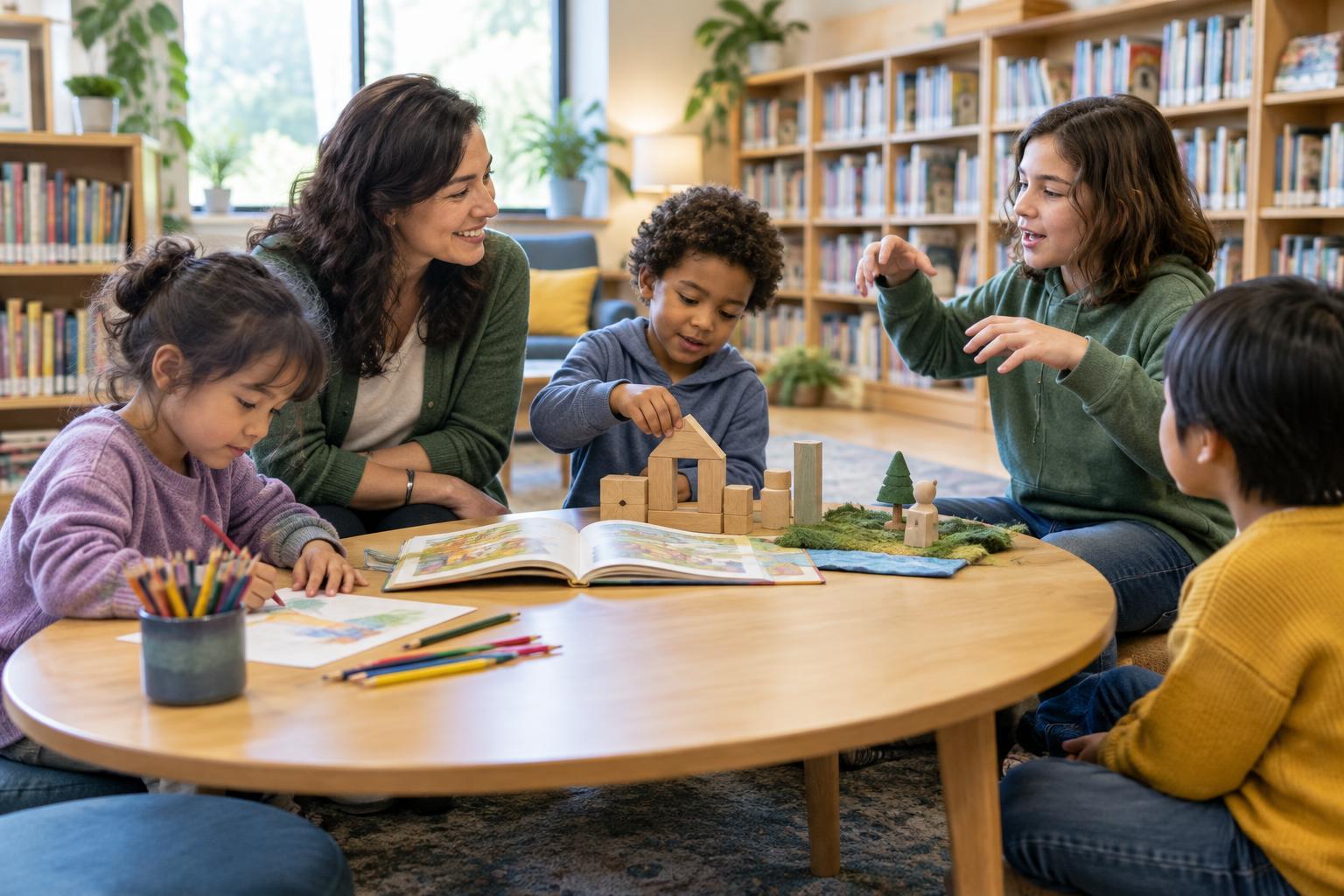
They are a friendly activity after finishing a book, but you do not need to borrow that book’s characters or setting. A story about a sea voyage might inspire dice covered in boats, maps and mysterious objects. The rolls can then lead somewhere entirely new. Children, teens and adults can all play; the storyteller can speak, write, draw or act out what happens.
Make a small set from paper
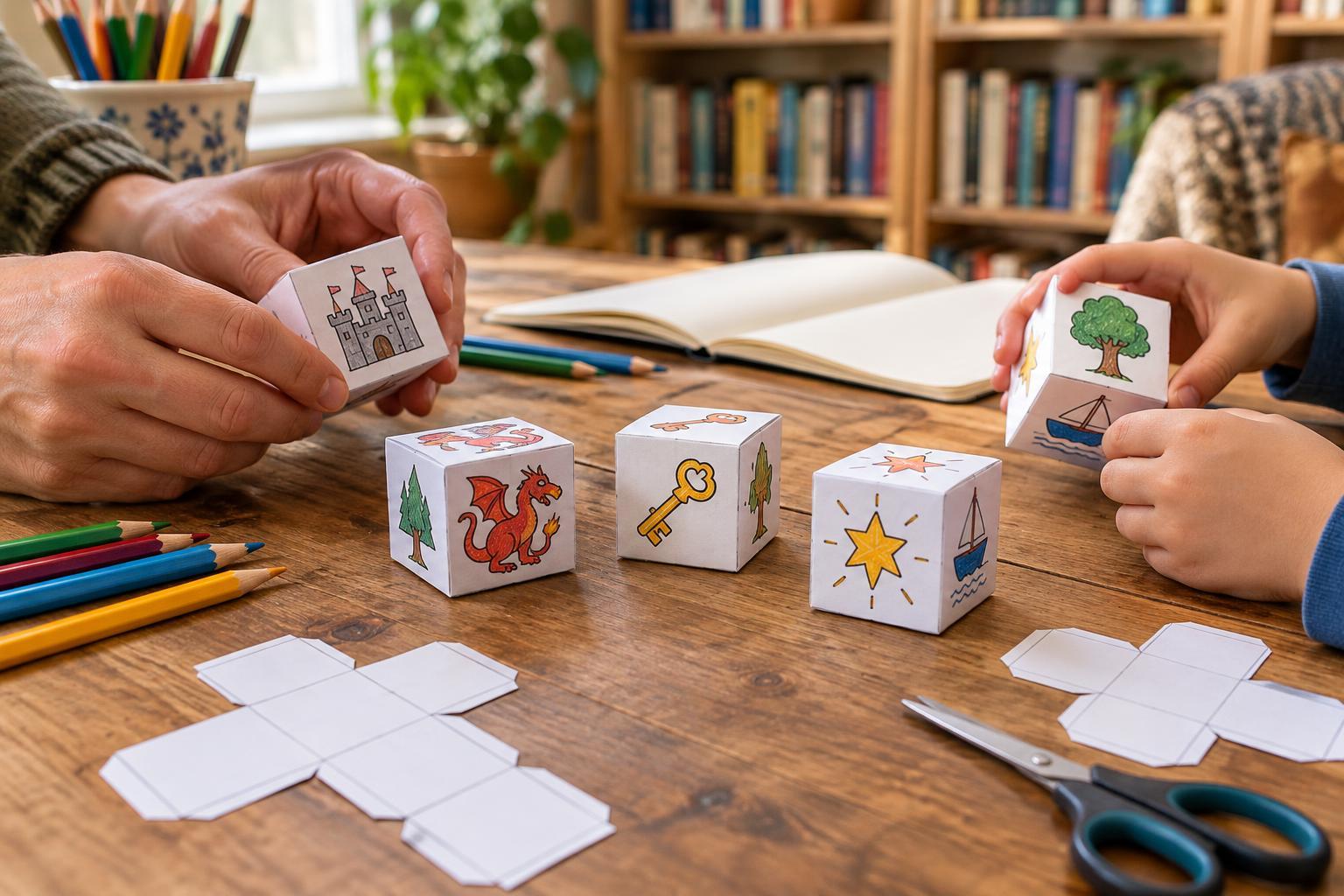
Start with three dice: one for a character, one for a place and one for a surprise. For each die, draw a cube net on sturdy paper or light card: four equal squares in a row, with one square attached above the second square and another below it. Add small tabs along a few outer edges for gluing. If drawing a net feels fiddly, use a printable blank cube template or decorate the faces of plain craft cubes instead.
Put a simple image on each face before folding. A character die might show a gardener, a dragon, a robot, a child, a bird and a detective. A place die could offer a library, cave, rooftop, train, garden and island. For surprises, try a missing key, an unusual sound, a gift, a sudden change of weather, a secret message and an unexpected visitor. Clear symbols leave plenty of room for interpretation; artistic skill is not required.
Cut out the nets, fold along the lines and secure the tabs with glue or tape. Let the cubes dry before rolling. If you are making them with young children, an adult can handle cutting, and larger paper cubes may be easier to hold. Keep small craft materials out of reach of children who might put them in their mouths.
Turn a roll into an adventure
Roll all three dice and begin with one sentence that links the results: “A gardener arrived at the library with a secret message.” Then ask a question that creates movement. Who sent the message? Why did it arrive here? What must the gardener do next? The dice provide starting points, not rules, so players can interpret a picture in whatever way helps the story.
For a quick round, give each person a turn to add one or two sentences. Encourage the next storyteller to build on what has already happened rather than start over. If the story stalls, ask, “What does the character want?” or “What makes that harder?” You can roll one die again to introduce a new detail. Stop when the group reaches a satisfying ending, even if some pictures have changed meaning along the way.
There is no need to judge whether a contribution is clever enough. A quiet player might prefer to sketch the scene or choose between two possible next steps. Someone else might enjoy performing a character’s voice. Treat surprising ideas as invitations: the unlikely combinations are often what make the game fun.
Try different ways to play
For a mystery, add a clue die with faces such as a footprint, a torn note or an empty box. For a journey, create a helper die and an obstacle die. Readers who love a particular genre can choose pictures that evoke it without copying a favorite plot. A space-themed set might include a greenhouse, a broken radio and an unfamiliar map; a cozy set might include a bakery, a lost mitten and a new neighbor.
You can also change how the rolls work. Roll one die at the start of each scene, or roll several and challenge the group to use every image before the ending. For a solo activity, write three short paragraphs: the opening, the complication and the resolution. Keep a notebook of favorite combinations so an unfinished idea can become a comic, a bedtime tale or a longer piece of writing later.
Make the set your own
Invite everyone who will play to suggest pictures for the dice. A mix of familiar things and puzzling ones gives storytellers something to hold onto and something to wonder about. If a face repeatedly causes confusion rather than curiosity, replace it with a clearer drawing or add a word beneath the image.
Store the finished dice in an envelope or small box with a pencil and a few blank cards. The cards can hold new characters, titles or questions when a roll sparks an idea worth saving. Over time, the set becomes a little collection of shared possibilities: ready whenever a story needs its first unexpected turn.