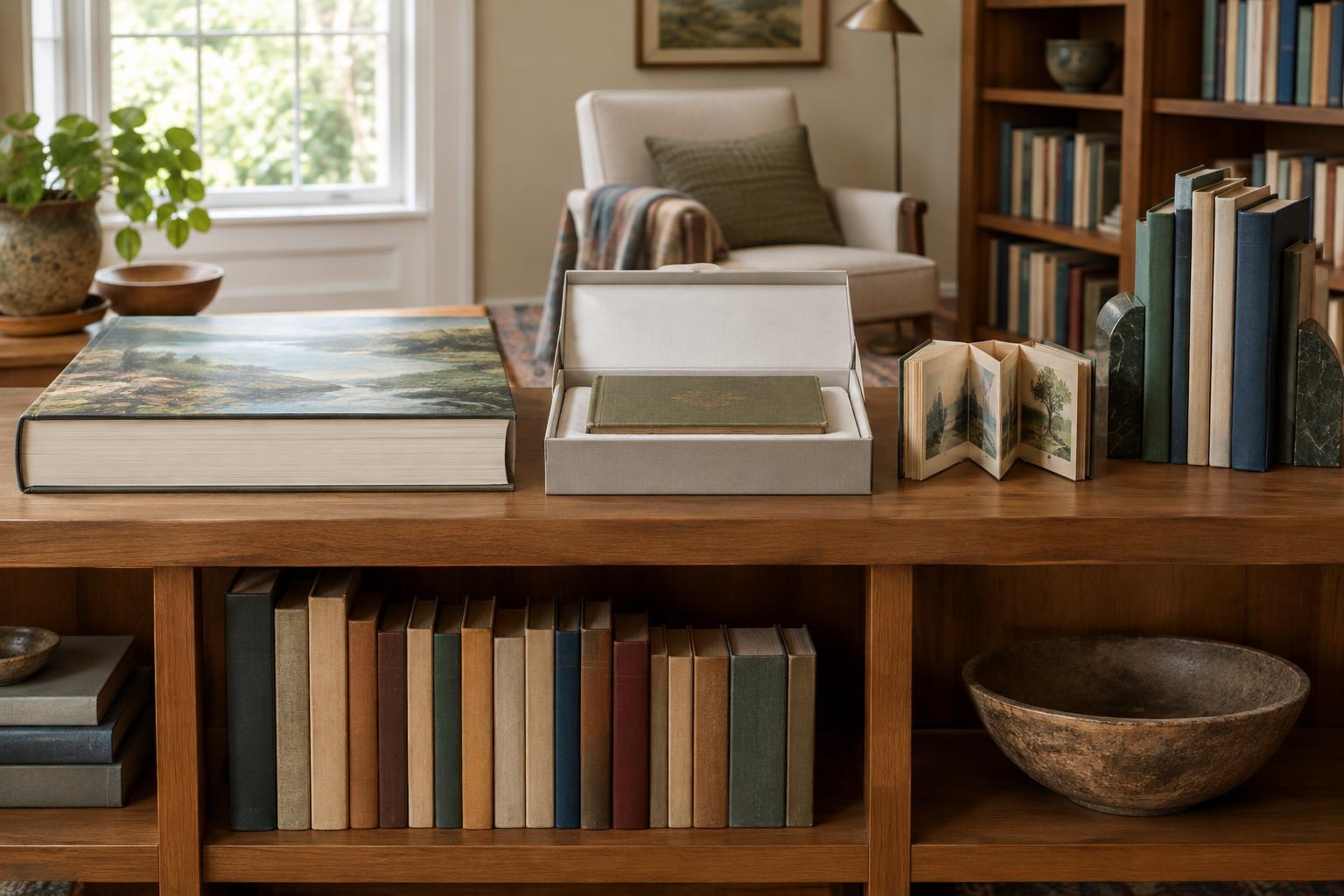
Let the book’s shape guide its storage
Most shelves are arranged by subject, author or color. Awkward books ask for a different question first: what position lets this particular book rest without strain? A heavy atlas, a slim booklet and a pop-up book may belong together in a catalog, but they need not sit together physically. Start by looking at each book’s size, weight, binding and any parts that extend beyond its covers.
Make a small holding area while you assess them, rather than trying to squeeze each one into the nearest gap. A book that leans, overhangs a shelf or has to be tugged free is telling you that its current spot is not working. You can still keep your collection easy to find by noting where books are stored in a simple list or shelf map.
Give large and heavy volumes full support
Oversized books often fare better lying flat on a sturdy, level shelf than standing upright with their weight pulling on the binding. Keep a flat stack short enough that you can lift a book without dragging it out from under several others. Put the largest, strongest volume at the bottom, and avoid placing a heavy book on top of one with a delicate cover, raised decoration or loose pages.
If a large book stands upright, its covers and text block should fit on the shelf without hanging over the edge. Firm, smooth bookends can help keep it vertical; tight packing cannot. Check that the shelf itself does not bow under the load. Deep shelves, low shelves or a stable cabinet may be more useful for big volumes than a tall display shelf.
To move a heavy book, clear a landing space first and use both hands to support it. Avoid lifting it by the top of its spine. For reading, a clean table with enough room to open the covers comfortably is usually kinder to the book than balancing it on your lap.
Protect fragile books without hiding problems
A book with a detached cover, brittle paper or a weak spine needs less pressure and less handling, not a tighter place on the shelf. Do not force it upright between sturdier neighbors. A well-fitting, supportive box or enclosure made from materials intended for book storage can keep loose parts together and shield the book from dust. An enclosure should hold the book securely without compressing it.
Keep any detached pieces with the book, but avoid taping them back in place or making an improvised repair. Household tapes and glues may be difficult to remove and can leave damage. If a book is especially valuable to you, or its condition is worsening, a qualified book conservator can help you decide what care is appropriate.
Even with protective storage, check fragile books now and then. Look for new warping, loose material or signs of dampness. Catching a change early gives you a chance to reconsider the storage spot before more handling adds to the problem.
Make room for unusual formats
Pop-up books, books with foldouts and volumes with attached objects need space around their moving or projecting parts. Before closing one, make sure everything is folded back as intended; do not press down to make a stubborn page lie flat. Store it where neighboring books will not crush its contents. A protective box may be useful for an irregular shape, provided nothing inside is bent to make it fit.
Very thin books and booklets can disappear between larger volumes or slump when shelved alone. Grouping them in a suitably sized box can make them easier to locate and handle. For a book with an unusual binding or covers of different sizes, choose a position that supports its whole body rather than assuming it must stand with the spine facing out.
Accessibility matters, too. A carefully stored book is not well placed if reaching it means shifting a precarious pile. Keep frequently used items within easy reach and reserve less convenient spaces for books you handle rarely.
Choose a steady spot and revisit it
Aim for a clean, dry place with a reasonably steady environment. Direct sunlight can fade covers, while damp areas and frequent temperature swings may be hard on paper and bindings. Avoid storing books directly on a floor where a small spill could reach them. Leave enough room to lift books out without scraping their covers against furniture.
A home library can change as new books arrive, so treat your arrangement as something to maintain rather than finish once. Dust shelves gently, make sure stacks remain stable and move books that have begun to lean or feel crowded. The goal is not a perfectly uniform bookshelf. It is a collection in which each book has the support it needs and a reader can find it without causing damage.