Find the game hiding in the story
Begin with a story everyone playing knows, or read a short one together. Ask three questions: What does the main character want? What stands in the way? What choices help them move forward? A journey to a distant place might suggest a path across a board. A mystery might suggest collecting clues. A story about building a friendship could become a cooperative game in which everyone works toward the same goal.
You do not need to retell every chapter. Choose one challenge that feels fun to play, then give players a clear objective: reach the library before closing, gather three lost objects or help every character find their way home. If the story has a difficult or frightening moment, you can adapt its shape without recreating its intensity. A blocked road, for example, can become a puzzle or an invitation to take a different route.
Sketch a board from the obstacles
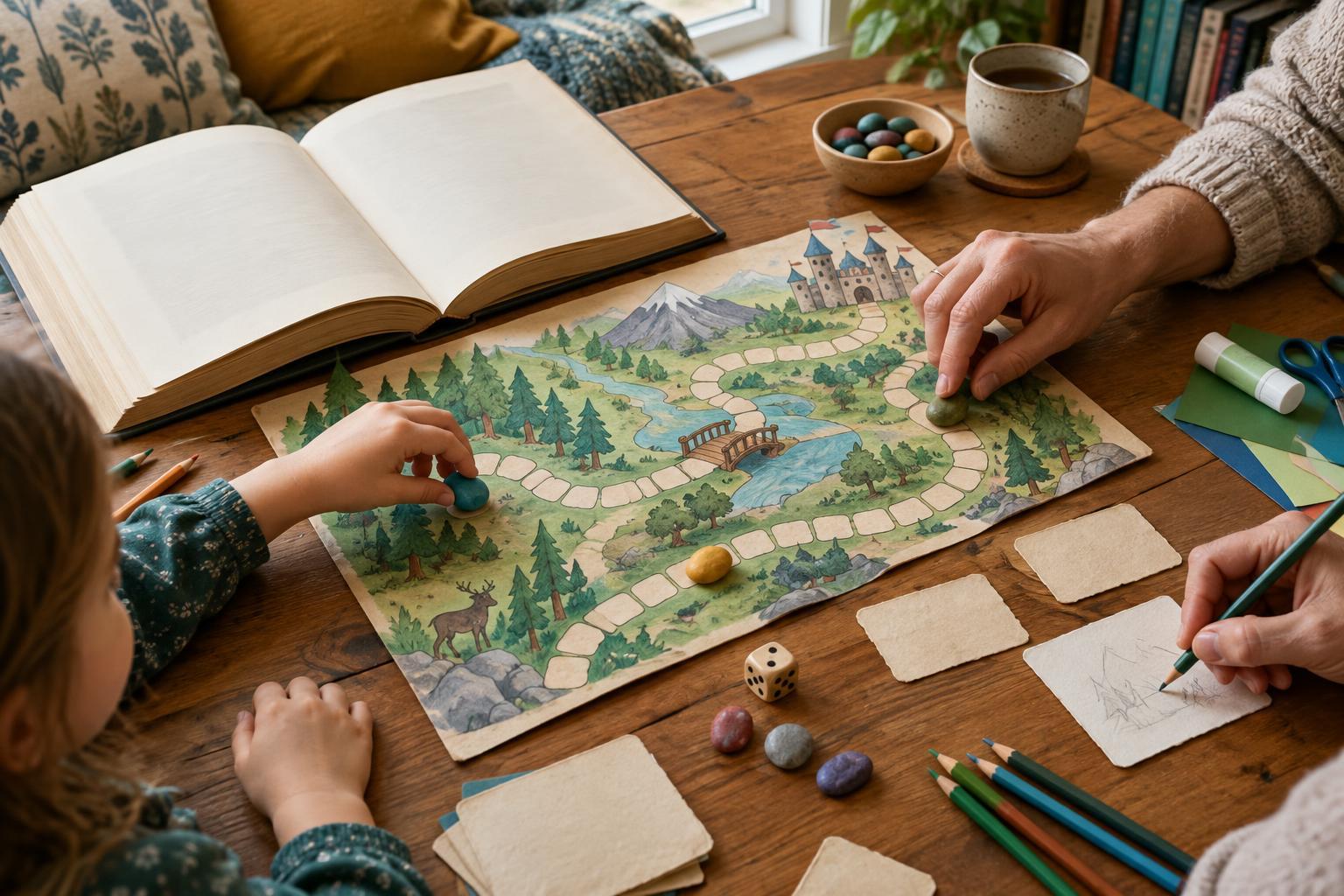
A sheet of paper, cardboard from a package or the back of an old poster makes a board. Draw a route of connected spaces, a small map with several paths or a set of locations players can visit in any order. Mark the start and finish, then add a few places that recall the story: a bridge, a garden, a hidden room or a busy town square. Simple drawings and labels are enough.
Give some spaces a purpose. A challenge space might ask a player to solve a riddle or trade an item. A helping space might offer a shortcut or a clue. Leave ordinary spaces between special ones so that every turn does not require a new decision. Buttons, paper circles or small toys can serve as playing pieces; a single die or a stack of numbered slips can control movement.
Make choices matter without making rules complicated
The most satisfying challenges grow from the story rather than appearing at random. If the characters relied on observation, let players notice a detail in a drawing to earn a clue. If they had to share supplies, give players a limited set of tokens they can trade or save. Keep each instruction short enough to read aloud in one breath, and write it on a card or directly on the board.
Try offering two reasonable options at a turning point: take a longer, safer path or use a token to cross a shortcut. Neither option has to be the “correct” answer. Choices give players something to discuss and let them see how a character’s problem can have more than one solution. For younger players, use pictures and a small number of repeatable actions. Older players may enjoy adding clue cards or a rule that changes halfway through the game.
Test a quick version before decorating
Play once with rough pieces and unfinished drawings. Notice where the game slows down. Are players waiting too long for a turn? Is one route always better? Can someone explain what to do without checking the rules repeatedly? A test game helps you spot these problems before you spend time making the board beautiful.
Change only one or two things at a time. Shorten a winding path, remove a confusing card or let players choose between two rewards. Decide together how the game ends and what happens if a player runs out of tokens. In a cooperative game, the group might win by completing a shared task. In a race, consider giving players who fall behind a useful choice rather than leaving them with nothing to do.
Use the finished game to revisit the book
Once the rules work, add color, character portraits, place names or a cover for the game box. Players can also invent a challenge that belongs in the story’s world but never appeared on the page. Ask how their new obstacle might change the character’s journey. This keeps the activity creative rather than turning it into a test of who remembers the most details.
After playing, talk about the decisions that surprised you. Did anyone take a route the character would have avoided? Was it easier to succeed by competing or helping? There is no need to agree on a single interpretation. The board game is a way to spend more time with a story, notice what makes its challenges interesting and make something new together.