Start with the question, not the search result
Imagine you want to learn about a newly discovered animal. You might ask three different questions: What kind of animal is it? What happened when it was discovered? How did researchers identify it? Those questions call for different sources. An encyclopedia can introduce the animal’s wider group, a news report can explain the announcement, and a research article can describe the evidence behind the identification.
None of these sources is automatically the “best” one. The useful choice depends on what you need to know, how much detail you can use and whether timing matters. Before opening another search result, put your question into a sentence. Then look for a source made to answer that kind of question.
Use an encyclopedia to get your bearings
An encyclopedia is a strong starting point when a subject is unfamiliar. Its entries usually define terms, introduce important ideas and place a topic in context. If you are beginning a project about wetlands, an encyclopedia entry might help you understand what counts as a wetland and which questions are worth exploring next.
Because an entry aims to give an overview, it may not explain a particular event or study in much depth. It may also be less useful when your question depends on a recent development. Check who produced the encyclopedia, whether the entry names its contributors or references, and when it was last updated if that information is available. Treat the entry as a map: useful for finding your way, but not necessarily the final stop.
Use a news report to understand an event
A news report is useful when you want to know what happened, where and when it happened, and why people are paying attention. It may bring together statements from people involved, observations from a reporter and background that helps readers follow the story. For a recent library policy change, for example, a report might explain the decision and describe how different people responded.
News is often written while a story is still developing. Early details may be incomplete, and a headline may simplify a more careful article. Read beyond the headline and notice what the report directly establishes versus what a quoted person claims. Look for named sources and links or references to relevant documents when available. If your question is about an ongoing event, compare reports published at different points in the story rather than assuming the first account has the last word.
Use a research article to examine a study
A research article is a good choice when you want to know how investigators studied a question and what they found. Rather than only stating a conclusion, it can describe the methods, evidence and limitations. If a news report says a study found a connection between two things, the article can help you see what was measured and whether the authors are describing a connection or arguing for a cause.
Research articles can be technical, and one study rarely settles a broad question on its own. Start with the abstract for the main question and findings, then look at the methods and discussion for context. Pay attention to the size and nature of the study, what the authors say they could not determine, and whether the article has been reviewed by other specialists. Review can be valuable, but it does not make every conclusion certain. If the full article is difficult to read or unavailable, avoid making a stronger claim than the material you can check supports.
Let sources work together
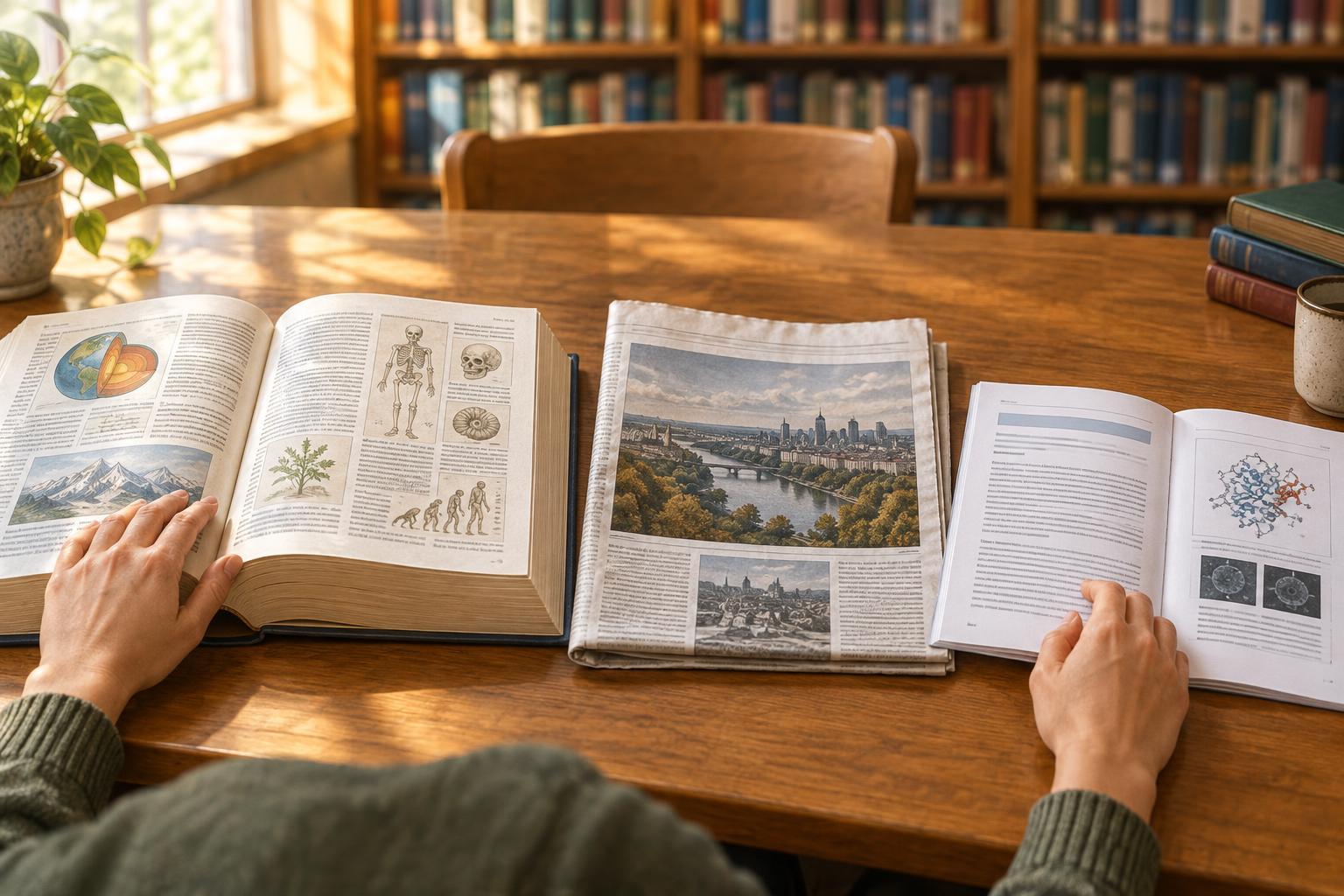
Often the most useful reading path begins with an encyclopedia, moves to a news report and then follows a link or citation to a research article. You do not have to follow that order every time. A news story might spark your question; an encyclopedia might clarify an unfamiliar term in a study. Moving between sources lets you check whether a simple explanation matches the more detailed evidence.
Try keeping a small question-and-source note as you read. Write down what you wanted to know, which source helped and what remains unclear. For instance: “The news report tells me when the discovery was announced, but I need the research article to understand how it was identified.” This habit makes it easier to choose the next source—and to explain why you trust an answer instead of merely repeating the first one you found.