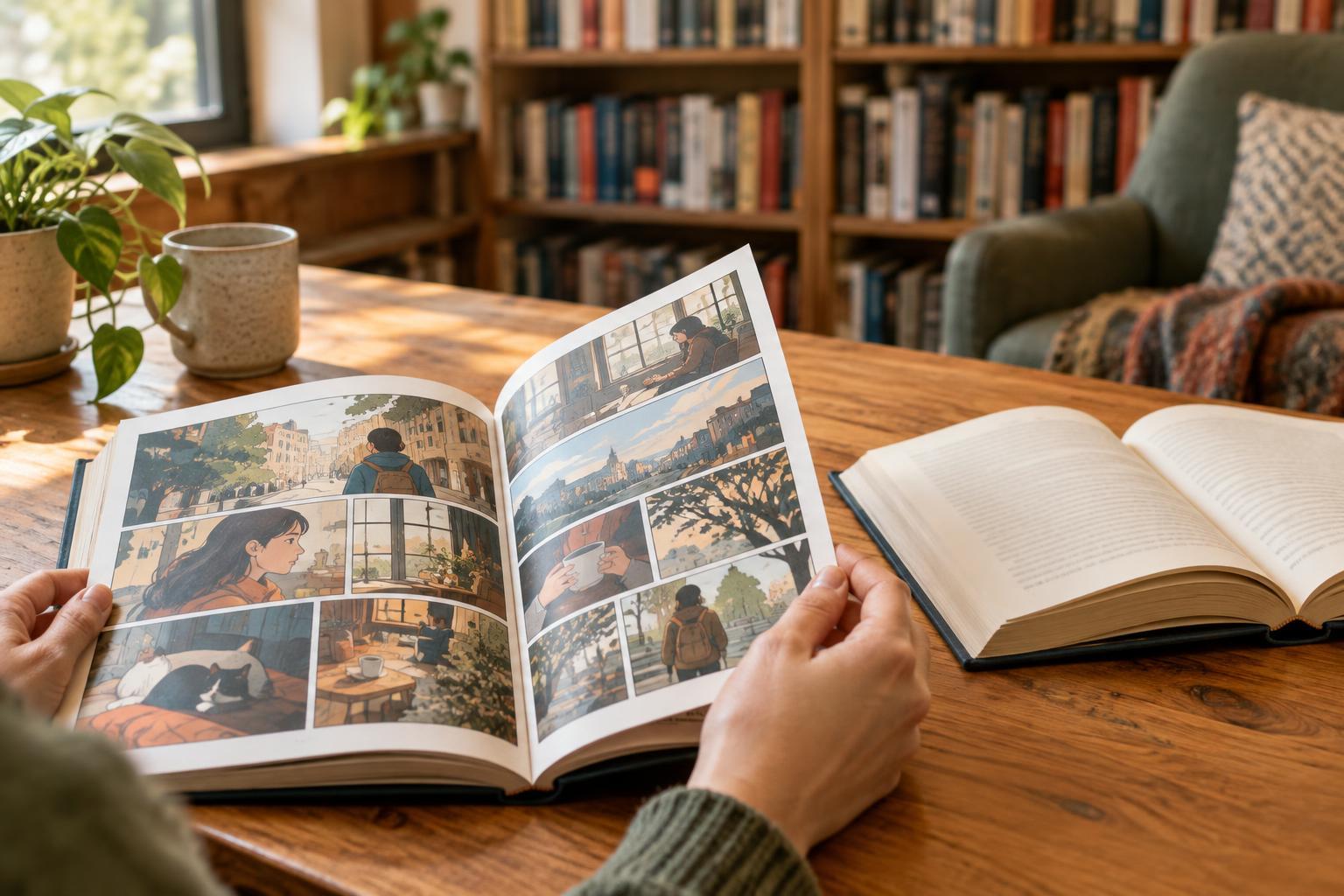
Start with a story you already like
If you usually read prose, the easiest way into graphic novels is through your existing tastes. Think about what keeps you turning pages: a sharp character voice, a mystery to solve, a vivid setting, or a quiet account of someone’s life. Graphic novels can offer all of these. The difference is that facial expressions, color, composition, and the space between panels carry parts of the story that prose might put into sentences.
Try matching your first pick to a familiar reading mood. If you enjoy memoir, look for a personal story about family, identity, work, or growing up. If you like literary fiction, try a character-driven book with room for everyday conversations. Mystery and fantasy readers can start with those genres too. You do not need to begin with superheroes, and you do not need to learn a shared fictional universe before opening a graphic novel.
Choose a manageable first book
A self-contained volume is often a comfortable starting point. You can finish a complete story without hunting down the next installment or wondering whether you have missed earlier events. Check the cover or catalog description for phrases such as “volume one” or “book one” if you would rather avoid a series for now. A collection of short comics can work well, too: each piece gives you a fresh chance to try a different style.
Before committing, flip through a few pages if you can. Are the lettering and panel order easy for you to follow? Do you want to linger over the art? A sample spread may tell you more than a genre label. Some books are dense with dialogue; others use long wordless passages. Neither is a better place to start for everyone. Pick the balance that feels inviting, even if it is not what you expected to like.
Let the pictures set the pace
Prose habits can make a graphic novel feel unusually quick at first. You may read every speech balloon and move on, only to sense that you have missed something. Pause occasionally to notice where a character is looking, what changes in the background, or how much time seems to pass between panels. An expression may complicate what a character says; a repeated image may draw attention to something they cannot say at all.
In many English-language graphic novels, you read panels from left to right and top to bottom, but layouts can vary. If a page feels confusing, follow the placement of the speech balloons and look for visual paths between panels. It is fine to backtrack. Rereading a spread to take in its details is part of the pleasure, not a sign that you are doing it wrong. If you try manga, check its reading-direction note; many editions are read from right to left.
Use browsing as a discovery tool
Library and bookshop shelves make it easy to compare graphic novels without needing a long list of recommendations. Browse by subject as well as format: graphic memoir, history, science, and fiction can all sit in different places. If the shelf is large, start by pulling a few books with premises you like, then compare their opening pages. A promising description matters, but so does whether you enjoy spending time in that book’s visual world.
You can also ask for a self-contained graphic novel similar in mood to a prose book you enjoyed. “Thoughtful and funny” or “an atmospheric mystery” is more useful than asking for the one graphic novel everyone should read. Remember that graphic novels are written for different age groups, just as prose books are. A bright art style does not necessarily mean a story is for children, and a dark cover does not guarantee adult themes.
Follow what worked, not a required reading list
After your first book, ask what you want more of. Was it the writer’s dialogue, the artist’s use of color, the genre, or the way the story handled a particular subject? That answer gives you a route to your next read. You might follow an artist into a completely different kind of story, or stay with a genre while trying a new visual style.
And if your first choice does not click, try another before deciding the format is not for you. Graphic novels range from spare and reflective to crowded and energetic. Finding an entry point is less about mastering a new set of rules than about finding a story whose words and images make you curious to turn the page.